 ’M A BIT LATE to the party. Copious ink has already been spilled regarding Cardinal Sarah’s address at the Sacra Liturgia conference in London and his comments regarding celebrating Mass ad orientem in the Novus Ordo (“New order of the Mass”). Robert Cardinal Sarah was appointed by Pope Francis as Prefect for the Vatican’s CONGREGATION FOR DIVINE WORSHIP in 2014.
I’ve watched as many have been freaking out over Cardinal Sarah’s encouragement to follow rubrics that have been in place for over fifty years since Vatican II. The anxiety was so palpable that United States Conference of Catholic Bishops Committee on Divine Worship felt compelled to diffuse the brewing controversy in a letter clarifying that “no changes to the General Instruction of the Roman Missal are expected at this time, nor is there a new mandate for the celebrant to face away from the assembly.”
No new instructions. No new mandate. That’s exactly right and exactly the point.
The overreaction to Cardinal Sarah’s address is quite understandable because precious few Catholics know what ad orientem in the Novus Ordo is and what it is not. Lack of knowledge is not the people’s fault. In fact, they deserve to know the truth. It is time for catechesis to begin and for ignorance to end so that the faithful may develop their own informed opinions.
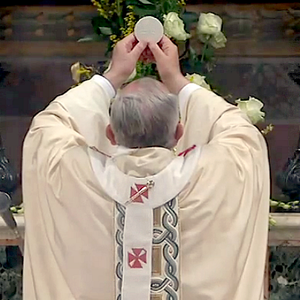
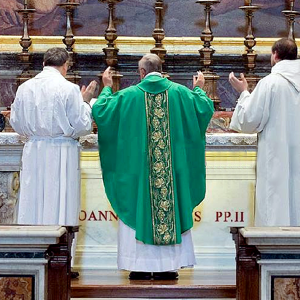
Andrew Leung has helpfully pointed out a few common misunderstandings. The most important misconception is that the priest faces the altar throughout the entire Mass. This is not even close to the truth. Leung sets the record straight in his article, Three False Ideas about “Ad Orientem” Celebration. The reality is a hybrid: the priest faces the people for most of the Mass, but faces the altar during the Liturgy of the Eucharist (with specific exceptions):
In the Novus Ordo, the priest begins the Introductory Rite at the presider’s chair, which faces the people in most cases. The Liturgy of the Word takes place at the ambo facing the people. The part celebrated ad orientem is the Liturgy of the Eucharist…After the Liturgy of the Eucharist, the priest returns to the presider’s chair for the Concluding Rite.
The following cannot be emphasized enough: When addressing the people (e.g., in the dialogues), the priest turns to face the people. When offering sacrifice to God, the priest faces the altar. Leung outlines the important distinctions, indicated in the rubrics here.
The priest is instructed by the rubrics to turn towards the people when he addresses them in the Liturgy of the Eucharist (at Oratre fratres; Pax Domini sit semper; and Ecce Agnus Dei).

 ETTING BACK TO THE “freaking out”—understand this: the Novus Ordo finds both acceptable and always has. It is not an “either/or” but “both/and.” While the Roman Missal assumes Masses are celebrated ad orientem (hence the rubrics specify “facing the people” at specific times) the General Instruction of the Roman Missal (controversy over translation aside) states the following: “The altar should be built separate from the wall, in such a way that it is possible to walk around it easily and that Mass can be celebrated at it facing the people, which is desirable wherever possible.” (GIRM §299)
I am not advocating one way over the other at this time because our greatest priority is to celebrate the Mass with dignity and reverence. Facing East or West is secondary for now. But some find ad orientem a useful tool to this end. Regardless, we have much to learn from each practice and from the collective wisdom of the ages.
 HILE “AD ORIENTEM” carries with it a good deal of emotional baggage for some, young Roman Catholics bring fresh perspectives not held by their parents and grandparents. With each passing year, the tide is turning. But adopting a different practice—even if from time to time—will be slow.
So what will this take?
THIS IS WHERE SOCIOLOGIST, Mark Granovetter comes in. His landmark 1978 publication Threshold Models of Collective Behavior (American Journal of Sociology 83 [May]: 489-515) is anything but dull. It has been applied to explaining everything from riots, the NFL draft, and miscues by politicos. (His theory is much discussed in this fascinating episode of WBEZ’s popular This American Life.)
Its main premise “is that of ‘threshold’: the number or proportion of others who must make one decision before a given actor does so.” Simply put, human nature dictates that many people are unwilling to act a certain way—even if one knows it’s a better choice—unless they see others doing it first. Many won’t “jump in” unless a large number of people are already engaging in a particular activity.
Key to this understanding, Granovetter explains that the “threshold” is different for different people. E.g., Many Millennials may have a lower threshold for adopting new digital technology while those of retirement age may have a higher threshold.
The threshold of a congregation is in play too, possibly causing the threshold of any pastor to be that much higher. What is required is a pastor with a “low threshold” who is willing to do the hard work of catechesis and willing to finesse the inevitable complaints that follow.
 HE “SPIRIT OF VATICAN II” sometimes contradicts Vatican II. For decades, we were told that the priest celebrated Mass (for over a millennium) with his “back to the people.” Quite interestingly, in the early 1990s, one of my choir members opened my eyes to a new way of thinking. It was new to me then and will be new to many today. He said, “You know, the old Latin Mass made sense in this regard: the people and the priest faced the same way. They faced God together.”
I propose the idea that the Novus Ordo, a hybrid of both facing the people and facing God, got it right—a “both/and” scenario consistent with both Vatican II and the “Spirit of Vatican II.”
I propose the notion that priest and people facing God together is an act of unity. “…they are to form one body, whether in hearing the Word of God, or in taking part in the prayers and in the singing, or above all by the common offering of the Sacrifice and by participating together at the Lord’s table. This unity is beautifully apparent from the gestures and bodily postures observed together by the faithful.” (GIRM No. 96)
I propose the possibility that doing so deemphasizes the centrality of the priest (a humble servant acting In persona Christi), places him in union with the faithful, and ultimately emphasizes the centrality of Christ.
I acknowledge the reality that most of the faithful are not ready to embrace ad orientem on a regular basis, if at all. Perhaps in time, those with a “lower threshold” will model this and more may someday follow.
I hope someday, ad orientem will be less frightening when people actually know what it is, why it is, and what it is not. My hope is that it will be normative—“no big deal!”
But most assuredly, Jesus loves you no matter which way the priest faces. Don’t freak out!